top of page
2.png

All Posts

When it comes to audio quality, the material of your speakers plays a crucial role. Among various options, wooden premium speakers stand out for their exceptional sound performance. Wood has been used in speaker construction for decades, and its natural acoustic properties make it a preferred choice for audiophiles and casual listeners alike. This article explores why wooden speakers deliver superior sound, highlighting the science behind it, design benefits, and practical tips for choosing the right wooden speakers for your needs.


The Acoustic Advantages of Wooden Premium Speakers


Wood is a natural material with unique acoustic properties that enhance sound quality. Unlike plastic or metal, wood has a complex cellular structure that absorbs and diffuses sound waves in a way that reduces unwanted vibrations and resonance. This results in clearer, warmer, and more natural sound reproduction.


  • Vibration Control: Wood naturally dampens vibrations, preventing distortion and ensuring that the sound remains pure.

  • Sound Warmth: The density and grain of wood add warmth to the audio, making music sound richer and more inviting.

  • Resonance Management: Wooden cabinets can be designed to resonate at frequencies that complement the speaker drivers, enhancing bass response and overall tonal balance.


For example, a high-quality wooden speaker cabinet can reduce the harshness often found in metal enclosures, providing a smoother listening experience. This is why many premium speakers use wood or wood composites in their construction.


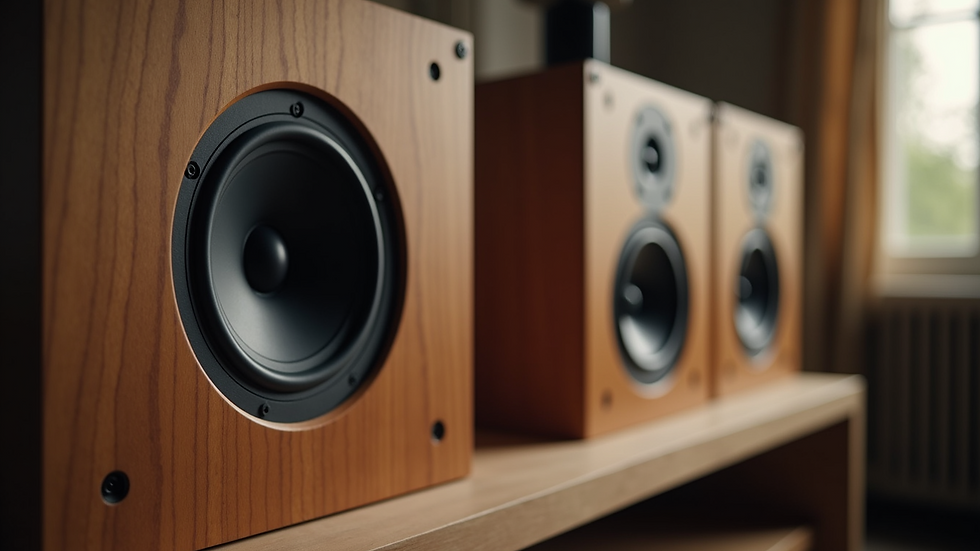
Close-up view of wooden speaker cabinet showing grain texture
Wooden speaker cabinet close-up showing natural grain

Close-up of a wooden speaker cabinet highlighting the natural grain and finish.


Design and Craftsmanship in Premium Speakers


The design of wooden premium speakers is not just about aesthetics; it directly impacts sound quality. Skilled craftsmanship ensures that every detail, from the type of wood to the thickness of the panels, is optimized for acoustic performance.


  • Material Selection: Different woods like oak, walnut, and maple have distinct acoustic characteristics. For instance, hardwoods tend to produce a brighter sound, while softer woods offer a warmer tone.

  • Panel Thickness and Bracing: Proper thickness and internal bracing reduce cabinet vibrations and prevent sound coloration.

  • Finish and Sealing: A well-finished wooden cabinet prevents air leaks, which can degrade bass response and overall sound clarity.


Many audiophiles prefer handmade wooden speakers because the attention to detail in crafting each unit results in superior sound and durability. Handmade speakers often use traditional joinery techniques and high-quality finishes that enhance both performance and longevity.


Eye-level view of artisan crafting wooden speaker cabinet
Artisan crafting wooden speaker cabinet

An artisan carefully crafting a wooden speaker cabinet by hand.


How Wood Enhances Speaker Performance


Wood’s natural properties contribute to several key aspects of speaker performance:


  1. Improved Bass Response

    Wooden cabinets provide a solid, non-resonant enclosure that supports deep, tight bass. The density of wood helps prevent unwanted vibrations that can muddy low frequencies.


  2. Enhanced Midrange Clarity

    The midrange frequencies, where vocals and many instruments reside, benefit from wood’s ability to absorb and diffuse sound waves. This results in clearer, more detailed audio.


  3. Natural Soundstage

    Wood helps create a more natural soundstage, giving the impression of space and depth in the music. This makes listening more immersive and enjoyable.


  4. Longevity and Stability

    Wood is durable and stable over time, meaning wooden speakers maintain their sound quality longer than many synthetic materials.


These performance benefits make wooden premium speakers a smart investment for anyone serious about sound quality.


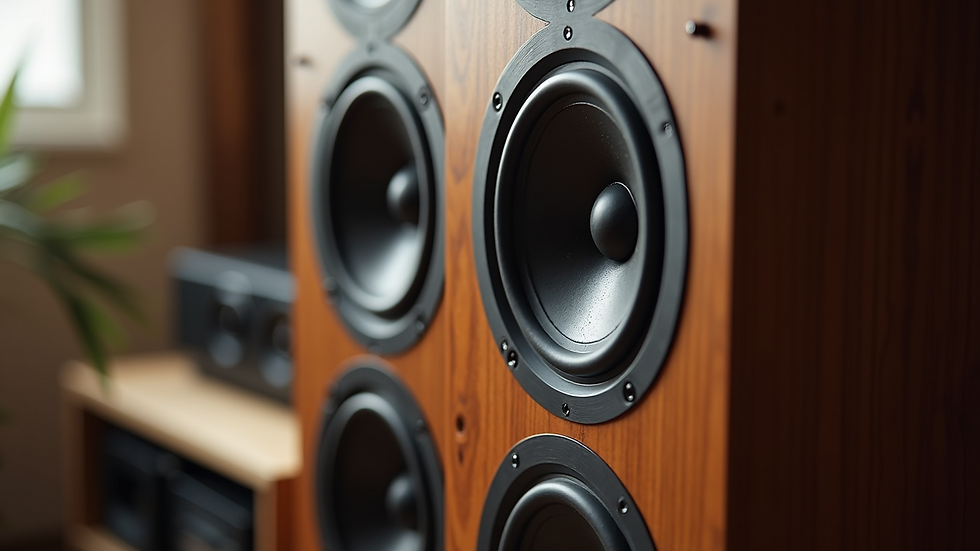
High angle view of wooden speaker with visible drivers
Wooden speaker with visible drivers

High angle view of a wooden speaker showcasing its drivers and cabinet design.


Practical Tips for Choosing Wooden Premium Speakers


If you’re considering wooden premium speakers, here are some practical tips to help you make the best choice:


  • Check the Wood Type: Different woods affect sound differently. Research the wood used in the speaker cabinet and choose one that matches your sound preference.

  • Look for Quality Craftsmanship: Handmade wooden speakers often offer better build quality and sound performance. Pay attention to joinery, finish, and internal bracing.

  • Consider Speaker Size and Room Acoustics: Larger wooden speakers can produce more bass but require more space. Match the speaker size to your room for optimal sound.

  • Test Before You Buy: Whenever possible, listen to the speakers in person. Pay attention to clarity, warmth, and bass response.

  • Maintenance: Wood requires some care to maintain its appearance and acoustic properties. Use appropriate cleaning products and avoid extreme humidity.


By following these tips, you can find wooden premium speakers that deliver the sound quality and aesthetic appeal you desire.


The Timeless Appeal of Wooden Premium Speakers


Wooden premium speakers are more than just audio devices - they are pieces of art that combine technology and craftsmanship. Their timeless appeal lies in their ability to deliver superior sound while adding warmth and elegance to any space.


Whether you are a music lover, a home theatre enthusiast, or someone who appreciates fine craftsmanship, wooden speakers offer a unique listening experience that synthetic materials cannot match. Investing in quality wooden speakers means enjoying rich, natural sound for years to come.


Explore the world of handmade wooden speakers to discover how tradition and technology come together to create exceptional audio products.


By understanding the acoustic benefits, design considerations, and practical aspects of wooden premium speakers, you can make an informed decision that enhances your listening experience. Embrace the natural warmth and clarity that only wood can provide and elevate your sound system to new heights.


Choosing the right headphones can transform your listening experience. Whether you enjoy music, podcasts, or gaming, the perfect pair can make all the difference. But with so many options available, how do you know what to look for? This guide will help you understand the key features and considerations when selecting headphones that suit your needs.


Key Features to Consider in Headphones


When shopping for headphones, several factors influence comfort, sound quality, and usability. Here are the most important features to keep in mind:


Comfort and Fit


Comfort is crucial, especially if you plan to wear headphones for long periods. Look for:


  • Adjustable headbands to fit different head sizes.

  • Padded ear cups made from soft materials like memory foam or leatherette.

  • Lightweight design to reduce pressure on your head and ears.

  • Over-ear vs. on-ear: Over-ear headphones usually provide better comfort and noise isolation, while on-ear models are more compact.


Sound Quality


Sound quality depends on the headphone drivers and design. Key aspects include:


  • Frequency response: A wider range (20 Hz to 20 kHz) covers most audible sounds.

  • Driver size: Larger drivers often deliver richer bass and clearer sound.

  • Impedance: Lower impedance headphones (under 50 ohms) work well with portable devices, while higher impedance models may require an amplifier.

  • Noise isolation or cancellation: Passive isolation blocks external noise with ear cup design, while active noise cancellation uses electronics to reduce ambient sounds.


Durability and Build Quality


Headphones should withstand daily use. Look for:


  • Sturdy materials like metal or reinforced plastic.

  • Detachable cables for easy replacement.

  • Sweat and water resistance if you plan to use them during workouts.


Close-up view of black over-ear headphones on a wooden table
Comfortable over-ear headphones with padded ear cups

How to Choose the Right Headphones for Your Needs


Different activities require different headphone features. Here’s how to match headphones to your lifestyle:


For Commuting and Travel


  • Noise-cancelling headphones are ideal to block out background noise on trains or planes.

  • Wireless models offer freedom of movement without tangled cables.

  • Foldable designs make storage easier in bags.


For Sports and Exercise


  • Sweat-resistant and secure fit headphones prevent slipping during workouts.

  • In-ear or earbud styles are often preferred for their lightweight and stability.

  • Wireless or true wireless options avoid cable interference.


For Gaming


  • Headsets with microphones allow clear communication.

  • Surround sound features enhance immersion.

  • Comfortable padding is important for long gaming sessions.


For Studio or Professional Use


  • Flat frequency response headphones provide accurate sound reproduction.

  • Closed-back designs help isolate sound.

  • Durability and replaceable parts are essential for frequent use.


What are the Best Headphones for Music Quality?


If music quality is your top priority, focus on headphones that deliver clear, balanced sound with rich detail.


Open-Back vs. Closed-Back


  • Open-back headphones allow air and sound to pass through the ear cups, creating a more natural and spacious soundstage. They are excellent for critical listening but leak sound and offer less noise isolation.

  • Closed-back headphones provide better noise isolation and bass response but can sound less airy.


Wired vs. Wireless


  • Wired headphones generally offer better sound quality due to direct audio transmission without compression.

  • Wireless headphones have improved significantly with technologies like aptX and LDAC but may still fall short of wired models in fidelity.


Recommended Features for Music Lovers


  • High-quality drivers (40mm or larger) for full-range sound.

  • Wide frequency response to capture deep bass and crisp highs.

  • Low distortion for clean audio at all volumes.

  • Comfortable design for extended listening sessions.


For those seeking high-quality headphones, investing in reputable brands and models known for sound excellence is worthwhile.


Eye-level view of open-back headphones resting on a wooden desk
Open-back headphones designed for superior music quality

Additional Features to Enhance Your Headphone Experience


Beyond basic sound and comfort, some features can add convenience and functionality:


  • Built-in microphone and controls for hands-free calls and easy music management.

  • Bluetooth multipoint to connect to multiple devices simultaneously.

  • App support for custom equaliser settings and firmware updates.

  • Quick charging for longer use with less downtime.

  • Foldable or collapsible design for portability.


Tips for Maintaining Your Headphones


To keep your headphones in top condition:


  1. Store them in a protective case when not in use.

  2. Clean ear pads and headbands regularly with a soft cloth.

  3. Avoid exposing them to extreme temperatures or moisture.

  4. Replace cables or ear pads as needed to extend lifespan.

  5. Handle with care to prevent damage to hinges and connectors.


High angle view of headphones placed inside a protective carrying case
Headphones stored safely in a protective case

Finding the Perfect Pair for You


Choosing the right headphones involves balancing sound quality, comfort, durability, and features. Consider how and where you will use them most. Test different styles if possible, and read reviews to understand real-world performance.


Whether you want immersive music listening, clear communication for gaming, or reliable headphones for daily commuting, the right pair is out there. Remember to prioritise your personal preferences and budget to make the best choice.


With the right knowledge, you can confidently select headphones that will provide enjoyment and value for years to come.


Wolf Acoustics Alpha Wolf Sound Beast Soundbar Plus Subwoofer Review

This Wolf Acoustics combo certainly plays as loud and brash as it looks. There’s plenty of bravado on movies and a surprising amount of clarity on music sources too. Whether it can really envelop you in 7.1 surround sound is questionable. And given that there’s no multi-channel licensing on hand here from Dolby or DTS, means Wolf might be excluding a big chunk of its potential home cinema audience. Others will certainly turn their noses up at the lack of Wi-Fi, app control or room correction for this price. But for those who just want a raucous party music machine and like their dinner served big with not much attention paid to the place setting, then Wolf Acoustics might endear its soundbar plus optional sub to a fanbase. The trouble for the company is that it could find its biggest challenge is identifying who those people actually are.


What Is the Wolf Acoustics Alpha Wolf Soundbar and Subwoofer?

Well, perhaps we must hand it to founder Mustafa Mehmet for having the gall to produce a small number of audio products off his own bat under the banner of his newly-formed Wolf Acoustics. The company is UK-based and Mehmet says his plan is to make ‘high end products for everyone to have access to’. Having learned to play the saxophone, achieved a music degree and studied sound engineering, he applied his knowledge to the pursuit of creating ‘something distinctive in the music space’. The Wolf name apparently derives from the unique sound that a pack of wolves uses to distinguish itself from other packs.

The company’s audio portfolio presently stands at four products. In addition to the Sound Beast soundbar and Studio Grade subwoofer we review here, Wolf also offers what it calls the Surround Sound headphones and the Sound Beast powered speakers.


The Alpha Wolf 7.1 Sound Beast (are there too many names in there?) soundbar itself doesn’t really resemble anything we’ve seen before. It’s more like one of those unapologetic black PA speaker blocks you might find at a disco or live event. We’ll discuss the individual drivers and layout in the next section. But we also look at, and listen to, the Alpha Wolf 12-inch sub, which differentiates itself little from the many such cuboid bass boxes that typically accompany budget speaker packages. Note that the soundbar’s MSRP of £2,999 has now been revised to £1,800.

Design

The soundbar section is big and heavy. To be precise, it’s 1.21 metres long and the 16 kg weight could be hernia-triggering if not handled carefully. It’s also worth dwelling for a moment on the 22 cm height because you won’t be able to shove this one on the shelf in front of the telly; it will block quite a lot of the picture. So, just as well Wolf Acoustics supplies hardware in the box to mount it onto a wall, and we assume most will choose to do exactly that.

... hernia-triggering if not handled carefully

The wood casing is formed from chunky MDF, although the front fascia employs a glossy piano black template into which the many drivers are mounted. There are also 12 rather aggressive looking male steel grille connectors which protrude from that front plate. The grille itself is a rather standard arrangement of stretched acoustically transparent material wrapped around an MDF frame.


There are 14 x 3-inch paper drivers, with two each assigned to L, C, R, SL, SR, SBL and SBR, while five 1-inch soft dome tweeters support each of the five main channels only (while excluding the rears). Two 6.5-inch bass drivers sit either side of the centre channel and there is a passive radiator port built into the right endcap. A central semi-circular panel includes a basic LCD display, USB in port and buttons for standby, input and track skip. Round the back is a recess on the left side for all the inputs. It should be noted that as the connection panel faces downwards, you might end up kinking the power, HDMI or other cords when the soundbar is on a level surface.


The Studio Grade subwoofer is rather generic, but nothing out of the ordinary for its below-£500 price point. The front square profile measures 35 cm x 35 cm with a 43-cm depth. This is the type of product you might find hawked along with a budget to mid-price 5.1 home cinema system. Its large and single 12-inch paper cone is mounted into gloss piano black frontage, similar to the bar, while the side casings employ a textured black wood veneer. The rear panel amp connection plate is functional with various connections as discussed below.

Features and Control

As far as control of the soundbar/sub combo goes, there is precious little at the user’s disposal. A responsive but basic plastic remote control allows manipulation of rudimentary EQ settings including independent volume buttons for each channel. There is also a ‘channel mode’ button which promotes playback of any source to map out to 2.1, 5.1 or 7.1. For example, you might choose to listen to a stereo source using the full array.

... at least some of these functions should be getting a look-in

There is no Wi-Fi, hard-wired Ethernet or network facility, nor is there any form of app control. When you’re hovering around the £2k mark, at least some of these functions should be getting a look-in. Not surprisingly, there is no form of in-room calibration procedure, other than the aforementioned ability to alter the volume of each channel independently. There is, however, a reliable Bluetooth 5.0 connection with aptX HD for 24-bit music support.


With eight Class D-based amp modules built in, there is a claimed 310 watts of power on offer from the bar and the frequency response spans 40 Hz – 20 kHz. The drivers themselves are classed as long-throw and onboard DSP ensures that the two pairs of outermost drivers will deliver virtual surround sound for a more spacious sonic envelope. We are told that a Qualcomm chipset decodes 5.1 and 7.1 sources, but the lack of Dolby or DTS licensed algorithms is another key omission from this platform.

... onboard DSP ensures that the two pairs of outermost drivers will deliver virtual surround sound

Inputs on the rear downward-facing overhang panel include 2 x HDMI, optical TOSLINK, coax, USB, L/R RCA and a karaoke microphone port. There is also a line-level output for an optional subwoofer and from which we linked the Wolf 12-inch model. The USB connections support MP3, WMA, APE and FLAC, so there are some further options for Hi-Res music playback.


The subwoofer sports 300 watts (RMS) of output into 4 ohms with a claimed frequency response of 20 Hz to 250 Hz. There are no published response or roll-off curves, so the low-end figure there might have to be taken with an eyebrow firmly raised. The sub includes a high-level connection, as well as RCA. There are further plastic rotary dials for gain, low pass filtering and phase control.

Set Up and Operation

We tried the Wolf bar/sub combo in both a TV room setting and in a dedicated cinema/listening room. In the latter environment, the bar straddled two sides of my equipment rack, but its topside was a few inches clear of a 2.35:1 projection screen. Direct sources in our test comprised a Panasonic DP-UB820 4K Blu-ray player (HDMI), TCL C845 Display (HDMI ARC) and Spotify (Bluetooth).

... there are some further options for Hi-Res music playback

The sub sat flush to side walls in both scenarios and was connected via a single RCA to the left/mono input. Because the soundbar itself produced quite a full-blooded response by itself, I found the optimal low pass setting on the sub to be around 75 Hz, rather than anything higher. You can disable the bass drivers on the bar and let the sub handle the balance of the output. Note that the sub did make an unwelcome ‘pop’ sound each time when triggered by an audio signal from the soundbar.

Performance

It would seem a crime not to first try out the Wolf set with some aggressive movie content. The opening section of Jurassic Park (1993, 7.1, 4K UHD) where the velociraptor cage is lowered onto the concrete plinth, elicited some clearly defined left/right panning. There were also some impressive and rooted bass effects as the forklift manoeuvred across the concourse. Even the left and right ‘surround’ speakers managed to project some effects and atmosphere out to the sides of the room. Dialogue also rose above the surface with good isolation and was generally natural and untainted. Unfortunately, when taxed with the first high-pitched velociraptor shriek, the 7.1 soundbar felt edgy and harsh. As a result, this high-frequency aggression could subject the listener to fatigue over prolonged sessions.

Dialogue also rose above the surface with good isolation and was generally natural and untainted

During the helicopter chase sequence of Mission: Impossible – Fallout (2018, 7.1, 4K UHD), the sound is big but brash all the same. You can pick out all those trumpets and trombones in the score and the chopper blades swirl convincingly in and out of the soundstage. There is some formidable weight here and you can’t deny the soundbar has balls. The trouble is that it all gets a bit overbearing, particularly when you crank up the volume a few notches. The bar has plenty of bass extension, so the need for the Studio Grade sub was questionable given the additional price proposal on the table.


There is another anomaly which didn’t sit well with me on music sources. Stereo music from Spotify or CDs sounded better in the 7.1 channel mode than in 2.1. This characteristic also applied to Orbital’s ‘Way Out’ track from the Spare Parts Express CD. The bar’s output on the number in 7.1 mode was spacious and the Wolf easily handled those clear, meandering keyboard signatures darting across the front stage along while amply supported by the throbbing bass line. But perhaps this soundbar is more suited to being a mega-competent party speaker. Would it fare better in a dance hall or on an outdoor deck? When defaulting again to 2.1 mode on the same track, that wide wrapper collapsed and tended to colour the music.

... you can’t deny the soundbar has balls

In the ‘Rex Tremendae’ from Karl Jenkins’s Requiem (Spotify), the plodding floor tom drums were powerful and the choral voices definable, but there was some midrange detail lacking. To add to that, bass descended into boominess, so the track improved in this case by completely disengaging the subwoofer.

Conclusion

Wolf Acoustics Alpha Wolf Sound Beast Soundbar Plus Subwoofer Review

Should I buy one?

... some impressive individual performance characteristics to enjoy with the soundbar

The Wolf soundbar and subwoofer are not necessarily a write-off. There are some impressive individual performance characteristics to enjoy with the soundbar, even if the optional and average sub seems surplus to requirements. The biggest challenge for this entrepreneurial company is that it needs to identify clearly who its target audience is. It’s not a refined enough product combo to challenge the likes of Sennheiser, Devialet or Sonos to top soundbar billing. Consequently, the price of the Wolf components doesn’t even really make sense in the current marketplace. And to omit some of the most imperative tech must-haves in this category will have many scratching their heads. The marketing and product naming convention also needs a radical overhaul.

... ultimately you must get the offering right

With all that said, Wolf Acoustics may get some traction with these products as they stand now. We understand the company has already shifted a fair few and believe it’s onto something. Wolf is also willing to keep the R&D engine alive (in cahoots with its Chinese manufacturer) and craft a 7.1 soundbar ‘V2’ in the future. Nobody is denying that developing and selling AV products isn’t a gargantuan and eye-wateringly costly task, but ultimately you must get the offering right. In its efforts, we certainly wish the company well. For the moment, the Wolf combo won’t attain a Recommended badge just yet, but we look forward to the next conquest.


bottom of page